
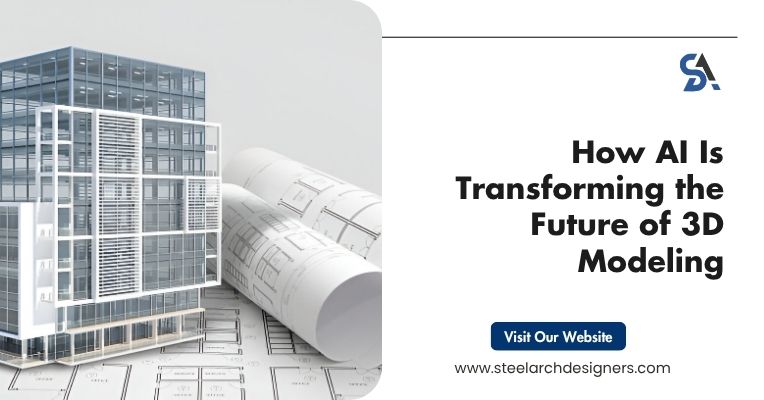
3D modeling has long been a crucial part of industries like architecture, product design, animation, and manufacturing. But today, with the rise of Artificial Intelligence (AI), this field is undergoing an exciting transformation. AI is not just speeding up the process—it’s making modeling smarter, more efficient, and more innovative than ever before.
At Steelarch Designers, we’ve embraced these changes to offer faster, smarter, and more precise design solutions. Whether you’re working on a building, a machine component, or a digital environment, AI is completely changing how models are imagined and created.
Let’s take a closer look at how AI is shaping the future of 3D modeling and why it matters to businesses and design professionals everywhere.
An Overview of 3D Modeling
3D modeling is the process of creating three-dimensional digital objects using specialized software. Unlike 2D drawings, 3D models have depth, height, and width, making them look more realistic and interactive. Designers use this technique to build models of buildings, machines, furniture, characters, and more.
From buildings and consumer products to characters and machinery, 3D modeling is used across industries to test designs, fix flaws, and explore ideas before physical production. It saves time, reduces costs, and improves accuracy in the planning and building stages.
How AI Is Revolutionizing 3D Modeling
1. Faster Design Process
AI tools can speed up the modeling process by automating repetitive steps. For example, instead of building a complex model from scratch, AI can suggest templates, auto-fill gaps, or generate parts based on previous designs.
2. Smart Recommendations and Corrections
AI can now identify design flaws or suggest improvements while you work. It can recognize if a structure won’t hold weight, or if something doesn’t align with industry standards.
This means fewer mistakes, better safety, and faster approvals.
3. Generative Design
One of the most exciting uses of AI in 3D modeling is generative design. With this, designers input basic requirements like size, material, and function—and the AI generates multiple design options automatically.
You don’t just get one model—you get several optimized versions to choose from.
4. Realistic Simulations
AI also helps create realistic simulations, which are especially useful in industries like architecture and product design. These simulations can test how a building will hold up in extreme weather or how a machine part performs under pressure.
This helps reduce physical prototypes and saves both time and money.
5. 3D Scanning and Reconstruction
AI can take images or scans of a real object and turn them into a complete 3D model. This is called AI-based 3D reconstruction, and it’s being used in everything from historical preservation to industrial reverse engineering.
For example, if a factory needs a digital version of an old machine part, AI can scan it and recreate it digitally—without needing the original blueprint.
6. Voice and Gesture Commands
With AI and machine learning, some 3D modeling tools now respond to voice commands or hand gestures. This makes the design process more interactive, especially for users working with AR/VR or remote design systems.
7. Integration with Other Technologies
AI doesn’t work alone. It’s now being combined with technologies like Augmented Reality (AR), Virtual Reality (VR), and 3D printing.
Imagine creating a 3D design with AI, visualizing it in AR, testing it in VR, and printing it with a 3D printer—all in one connected system. That’s not the future anymore—it’s already happening.
How Businesses Benefit from AI in 3D Modeling
At Steelarch Designers, we believe AI is not replacing designers—it’s empowering them. Here's how businesses benefit from this transformation:
-
Faster Project Delivery
AI speeds up the design cycle, meaning faster results for your clients. -
Cost Savings
Automation reduces time spent on manual tasks, lowering design and production costs. -
Higher Accuracy
AI reduces human error and improves model precision. -
Innovation Opportunities
With generative design, companies can explore bold, new ideas that may not have been considered before. -
Customization at Scale
AI enables the creation of personalized products or designs for each customer—without incurring extra time or cost.
Industries Benefiting from AI in 3D Design
- Architecture & Construction: Smart building models, structural analysis, and cost estimation
- Manufacturing: Product design, prototyping, and automation
- Gaming & Entertainment: Character creation, realistic environments
- Healthcare: Medical modeling, surgical simulation, and prosthetic design
- Fashion: Virtual clothing design and fitting
- E-commerce: 3D product previews and virtual try-ons
The Future of 3D Modeling
The future of 3D modeling is not just about better visuals—it’s about intelligent design.
As AI continues to evolve, we’ll see tools that:
- Learn from every project
- Create models with zero input
- Offer real-time design suggestions
- Predict performance before the model is complete
In short, AI will help designers dream bigger, build smarter, and deliver faster.
Final Thoughts
At Steelarch Designers, we embrace the power of AI to bring smart, efficient, and creative solutions to our 3D modeling services. Whether you're in architecture, product design, or industrial engineering, AI is the future, and we’re already making it part of our present.
If you’re looking to stay ahead of the curve and leverage the power of AI in your next project, connect with us today. Let’s build the future—smarter and faster.